
Restaurant SOP Manual in Saudi Arabia: Daily Operations That Work
Build a usable restaurant SOP manual in Saudi Arabia with opening, service, food safety, handover and exception routines plus a practical one-page procedure template.
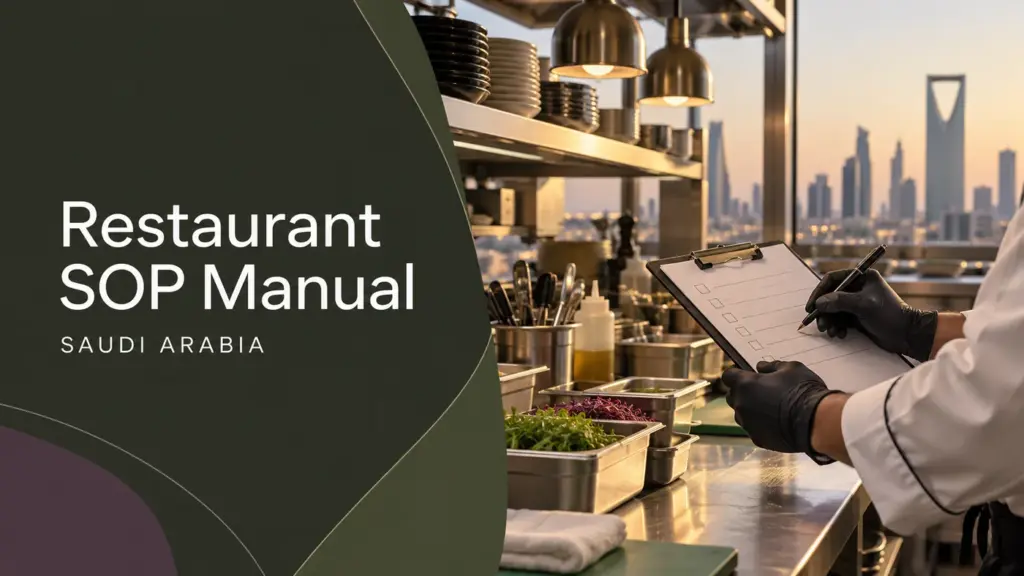
A supplier arrives during peak service, and the delivery does not match the approved specification. Does the employee know the next step—and who owns the decision?
- Write short procedures with clear owners and exception routes.
- Connect opening, briefing, service and handover.
- Record what happened and what needs action.
- Test the first procedures before expanding the manual.
This is a management framework, not regulatory approval or a complete food-safety programme. Competent personnel must set the venue-specific technical standards, authority and current requirements.
Take two blank templates into your working session ↓
What belongs in a restaurant SOP manual?
A standard operating procedure explains a repeatable task: its purpose, owner, trigger, tools, steps, acceptance standard, record and escalation route. A checklist confirms whether selected steps happened on a particular shift. A training guide teaches the skill behind the procedure. Keep these documents connected but distinct. A line saying “check the fridge” is weak if nobody knows the approved method, what to record or who to call when the result is outside the venue’s approved standard.
Begin with the guest journey and the operational risks: receiving, storage, preparation, service, ordering, payment, cleaning, closing and incident response. The TerraForce operations service links audits to daily practice, while the pre-opening checklist covers the earlier launch phase. Use this article to build the routines that keep working after the opening team leaves.
Three documents, three different jobs
SOP
How do I perform the task, and what happens if it fails?
Checklist
Were the selected tasks completed in this shift?
Training guide
How do I learn and demonstrate the skill?
A shift from readiness to handover
Readiness & opening
Responsible roleManager, kitchen and service
Work to coordinateUse the role-specific approved opening checks.
Evidence / recordRecord readiness and unresolved exceptions.
Team briefing
Responsible roleShift manager with relevant teams
Work to coordinateConfirm availability, demand, constraints and accurate messages.
Evidence / recordRecord decisions that affect the shift.
Service & handoff
Responsible roleKitchen and service leads
Work to coordinateFollow the approved recipe, order and handoff procedures.
Evidence / recordRecord exceptions and the responsible action owner.
Closing & handover
Responsible roleOutgoing and incoming supervisors
Work to coordinateReview open items, equipment and the next action.
Evidence / recordKeep one clear handover record.
Illustrative coordination framework. Assign actual roles and authorised exception decisions for your venue.
Make the work clear
1. Map the work before writing procedures
Follow an actual order through the restaurant. Who accepts a delivery from a supplier? Who checks the invoice and product condition? Who records a shortage? Who puts the item away? Then follow the product through preparation, cooking, service or delivery, payment and feedback. Observe more than one shift, because the written chart may differ from what happens at peak time. Ask staff which tasks are unclear, frequently repeated or passed between roles without an owner.
Map high-risk points first, then routine efficiency issues. Food handling, allergy information, cash control, complaint escalation and opening or closing security deserve clear ownership. A small independent café will not need the same document structure as a multi-branch group, but both need a reliable answer to “who decides?” Do not copy a generic manual before understanding the venue’s equipment, menu, layout and channels. The purpose of mapping is to make a procedure fit real work.
2. Write a one-page procedure staff can follow
Give each SOP an ID, short title, version date, owner and approver. State when it applies, what good completion looks like and which record proves it happened. Write steps in the order a team member performs them, using the terms and languages staff actually understand. Add a simple visual or photo when it prevents ambiguity, but verify that it depicts the current equipment and setup. Separate routine steps from the “stop and escalate” conditions. A procedure that hides an exception in a dense paragraph will be hard to use in a busy shift.
For example, a supplier receiving SOP can specify who checks the delivery, where it is received, what details are compared with the purchase order, how product condition is assessed under the venue’s approved controls and how discrepancies are recorded. The acceptance standard should be approved by the responsible food-safety and management personnel for the operation. If a delivery fails that standard, staff need authority to isolate it, document it and contact the designated manager. A handwritten tick without a decision route is not control.
A one-page procedure: supplier receiving
- SOP ID
- Assign the controlled reference.
- Version / review date
- Enter the current approved version.
- Approver
- Assign the competent approving role.
- Approved acceptance standard
- Insert the venue-specific approved criteria and their reference; competent personnel must define them.
- Purpose:
- accept only deliveries that meet the restaurant’s approved order and product standards.
- Owner:
- receiving team member;
- reviewer:
- shift manager.
- Trigger:
- any supplier arrival.
- Preparation:
- locate the purchase order, approved checking tools and record.
- Steps:
- identify supplier and items
- compare quantities and product details
- perform the checks required by the venue’s food-safety programme
- isolate discrepancies
- record acceptance or rejection
- and place accepted goods in the approved location without avoidable delay.
- Exception:
- if product condition, documentation or quantity fails the standard, do not quietly add it to usable stock. Record the issue and escalate to the manager for an approved decision.
- Evidence:
- delivery record with time, responsible person, result and corrective action.
- Review:
- inspect repeated supplier issues monthly and update ordering or supplier arrangements when necessary. This is a structural example; the venue’s competent personnel must insert its actual criteria and current legal requirements.
Give the exception its own route
Perform the approved check ↓
Complete the normal next step and record the actual result.
Follow the approved exception procedure; document the issue and escalate to the designated role.
The diagram does not define technical limits or grant decision authority. Those belong in the venue’s approved procedure. Never pre-fill monitoring results.
Start with one shared plan
3. Create role-specific opening routines
An opening checklist should distinguish the manager, kitchen, service and any delivery station. The manager confirms staffing, reservations or expected demand, equipment readiness, cash or payment setup and unresolved issues from the previous shift. The kitchen verifies approved safety checks, product availability, prep priorities, recipe cards and station readiness. Service checks the guest area, menu availability, current offers and the route for answering common questions. The exact checks depend on the format; an all-day café and a dinner restaurant have different opening rhythms.
Keep the list short enough to complete honestly. Name the person who signs each section and the manager who reviews exceptions. A “pass” must mean the location meets its defined standard, not that someone has been asked to look at it. If a required item fails, the team should know whether to repair, remove an item from sale, delay opening of a station or escalate. Record the action and time, not only the red mark. Repeated failures should feed equipment maintenance or purchasing decisions.
Opening checks by role
| Role | Example coordination area | Record of completion | Exception review |
|---|---|---|---|
| Manager | Staffing, demand, payments and unresolved issues | Time, actual result and responsible person | Follow the venue’s assigned decision route |
| Kitchen | Approved checks, product availability, recipes and stations | Actual observation and action where needed | Refer to the responsible culinary / safety role |
| Service | Guest area, current menu, offers and guest questions | Actual readiness and discrepancies | Confirm the accurate message with the supervisor |
| Delivery station, if used | Packaging, order route and handoff readiness | Actual check and unresolved issues | Use the designated supervisor and exception route |
4. Use a pre-service briefing to connect teams
Before a peak period, gather the people whose decisions affect the guest. Review bookings or expected order volume, sold-out items, substitutions, allergen or ingredient questions, staffing changes, promotional promises and known equipment limitations. The chef can explain timing or menu constraints; service can share questions heard from guests; the manager decides which message is accurate across channels. Make the briefing concise and record only decisions that must carry into the next shift.
For a campaign, verify that the advertised product is available and the kitchen can prepare the likely volume. The restaurant marketing plan explains why demand generation should follow operating capacity. If delivery apps, a QR menu and printed cards display different availability or prices, assign someone to correct them before orders arrive. A briefing turns a plan into one shared version of reality.
Support consistent service
5. Standardise recipes without ignoring the chef
Recipe SOPs should specify ingredients, yield, portion, method, presentation and permitted substitutions. Add photographs or measured references where they genuinely help. The chef or responsible culinary lead should approve changes and train the team before a new version is used. Keep an accessible master version; uncontrolled copies taped to stations create contradictory instructions. Record supplier substitutions and explain whether the guest-facing description must change.
Connect every recipe update to the cost sheet and menu. If the portion changes, contribution and guest expectation may change as well. Our companion menu engineering guide shows how to compare popularity and contribution without relying on food-cost percentage alone. The procedure makes that analysis real: a beautifully calculated recipe is useless if the shift consistently plates a different amount.
6. Put food-safety controls in the correct authority chain
Food safety must be designed and approved for the specific venue, activity and applicable Saudi requirements. Use current official references and the operation’s competent personnel when setting limits, monitoring methods and corrective actions. The restaurant requirements on Balady include operating and food-safety sections; the Saudi Food and Drug Authority food-hygiene guidance sets out general hygiene responsibilities. Check the current rules relevant to the licence and do not treat a foreign template as local law.
A practical SOP should identify the responsible role, the approved monitoring frequency, the tool used, where the record lives and the corrective step when a result fails. Record real observations, not pre-filled values. Train staff to stop and ask rather than improvise around a food-safety problem. Audits should look for whether the procedure is followed under real service pressure, not only whether a binder exists. Keep evidence accessible for the manager and relevant inspections under the venue’s retention rules.
7. Define order, handoff and complaint routes
Map how an order moves from the POS to kitchen and from kitchen to table, pickup shelf or courier. Specify who checks completeness, modifiers and timing. Make it clear when service may promise a time and when the kitchen must confirm it. For delivery, identify where the team verifies packaging and how it handles a missing item or delayed courier. The guest should not have to explain the same problem to three people while staff debate ownership.
A complaint SOP can classify immediate safety concerns, service recovery and ordinary feedback. State who may offer a remedy, what information is recorded and when management must be involved. Protect guest privacy in the record. Review patterns weekly: repeated late orders may point to capacity or menu complexity, while repeated wrong modifiers may point to a POS configuration or unclear recipe. The purpose is correction, not an impressive count of closed tickets.
8. Control purchasing and inventory with simple evidence
Purchasing SOPs should connect approved suppliers, ordering authority, delivery checks and invoice reconciliation. Stock records need a clear unit of measure and a location so counts can be repeated. Decide how discrepancies and damaged goods are documented, who approves a substitution and how the menu or recipe is updated afterward. A growing chain may need central controls; a single site still benefits from a predictable process that survives a manager’s day off.
Review waste by reason: preparation loss, spoilage, overproduction, returned food or an ordering error. A single “waste cost” total is too blunt to guide action. Compare inventory usage with sales and recipe expectations, while allowing for real yield variation. Avoid treating unexplained variance as proof of misconduct; investigate the process and data first. The feasibility guide can help owners connect operational decisions to the wider financial model.
Keep the next shift informed
9. Close the shift with a handover, not a signature alone
The closing checklist should cover the venue’s approved cleaning and storage controls, equipment status, cash or payment reconciliation, stock or prep notes, incident records and security steps. Assign each item to a role and have a manager review exceptions. A checklist can confirm completion, but the closing handover should also tell the next shift what changed: an equipment fault, a supplier delay, a sold-out dish or a guest issue awaiting response.
Give the incoming team one place to read unresolved items and the person responsible for each. If the same exception reappears daily, revise the root process. Do not let a long list of unchecked or automatically ticked boxes substitute for observation. In a multi-branch operation, use comparable fields while allowing site-specific details. The aim is continuity from one service period to the next.
Handover that gives the next shift a next step
| Open issue | Operational effect | Action already taken | Next owner | Follow-up time |
|---|---|---|---|---|
| Describe the issue and record time | State the affected task or station | Record the approved action and reference | Assign the actual responsible role | Set the review or escalation time |
10. Train, test and revise procedures
Staff should practise the task, demonstrate it and receive feedback before being marked competent. Reading a manual is not the same as performing an opening check or handling an allergen question. Provide a short version at the point of work and a fuller explanation for training. Where the team uses Arabic and English, check that the two versions mean the same thing and that supervisors can answer questions in the language used on shift.
Choose a few procedures to observe each week. Compare records with what happened, ask staff where steps are impractical and revise the document when equipment, menu or policy changes. Give every revision a date and owner; remove outdated copies. A recurring error is evidence that the process, training, resources or supervision needs work. Updating the SOP after a real incident is more useful than praising a manual that never changes.
How to measure whether SOPs work
Measure more than the number of documents. Useful signals may include completed checks, repeat exceptions, remake rate, order accuracy, waste by cause, equipment downtime, service time and guest complaints. State definitions and data sources. If order accuracy improves while service time worsens sharply, inspect the trade-off before calling the change a success. Compare like periods and note changes in volume, staffing and menu. The target is dependable service and risk control, not a perfect compliance percentage produced by automatic ticking.
Assign each signal to a decision. Frequent receiving exceptions may mean supplier review or clearer specifications. A high remake rate in one dish may require recipe training or a menu change. Repeated delays at handoff may require a station redesign. Review the results with people from kitchen, service and management so that no team optimises its own metric at the expense of the guest. Record what action was tried and revisit it.
A signal should lead to a review
| Observed signal | Investigate | Possible next action |
|---|---|---|
| Repeated receiving exceptions | Supplier specifications, checks and records | Review the supplier or clarify the procedure |
| Repeated remakes of one item | Recipe execution, training and order modifiers | Test a targeted training or process correction |
| Recurring handoff delays | Station capacity, responsibility and order flow | Review the handoff layout or sequence |
Common mistakes when building an operations manual
Copying a large generic binder is the first mistake. It creates procedures unrelated to the venue and staff stop reading. Writing a checklist without an owner or exception route is the second. A third is keeping contradictory versions on paper, in chat and in a shared folder. A fourth is turning a food-safety check into a tick box with no real observation. A fifth is measuring only whether forms were completed rather than whether errors, waste and guest problems improved.
Start small: select a few high-risk or frequently failing processes, write them clearly, test them during real shifts and improve them. Keep the language direct. Explain why the step matters when that helps staff make the right call under pressure. Do not promise that an SOP alone will raise profit by a fixed percentage. Results depend on the starting point, implementation and consistent management.
Catch these design failures early
Review the design of your procedure
Selections are not saved. Completion is not a compliance certificate, safety approval or operational readiness decision.
Questions before building the manual
How many SOPs does a small restaurant need?
There is no universal number. Cover the processes with meaningful safety, guest, cash or continuity risk first, then add those that repeatedly fail. One clear procedure used every day is better than many decorative pages. Keep role checklists short and connect them to fuller task instructions.
Who should write and approve them?
The people who perform the work should help describe it, the responsible manager should make ownership and decisions clear, and competent specialists should approve technical and safety controls within their scope. The owner or general manager should ensure the manual fits the business model and stays current.
Is a checklist the same as an SOP?
No. An SOP explains how to perform a task and what to do when it fails. A checklist records that selected tasks were completed in a particular shift. Both matter. A checklist without instructions can produce inconsistent interpretations, while instructions without a completion record may be hard to monitor.
Can one manual cover all branches?
Use a common standard for the brand, then document site-specific equipment, layout, suppliers, licences and escalation contacts. Compare shared measures across branches, but do not force a procedure that cannot physically work in one location. Control versions centrally and make the current local appendix easy to find.
Thirty days to a first working set
Week 1 · observe
Watch shifts and map the higher-risk handoffs.
Expected outputA task map, priority list and assigned owners.
Week 2 · write and test
Draft a small set with the people doing the work.
Expected outputProcedures tested against real equipment and workflow.
Week 3 · practise and record
Train, verify understanding and start recording exceptions.
Expected outputDemonstrated practice and one current instruction set.
Week 4 · review and maintain
Compare records with real service and revise impractical steps.
Expected outputA version owner, review rhythm and recorded next actions.
This is a suggested sequence, not a promise that every operation will be ready in 30 days. Expand after the first set is used reliably.
For a restaurant preparing a second site, combine this work with the design and launch service so layout and training support the same operating model. If you need help turning an audit into procedures and measures, speak to TerraForce about your format, locations and current operational bottleneck. A manual should reflect the way your restaurant actually works and the standard it intends to sustain.
Take two blank templates into your working session
Download a procedure card and handover record as a printable HTML file. Open it in a browser and use Print or Save as PDF. Fill the fields locally; this page does not submit or store your records.
Two blank templates · no sign-in needed
The download button needs JavaScript. You can print the article templates directly from your browser.