
Restaurant Rebranding in Saudi Arabia
Plan a restaurant rebrand with TerraForce. Learn what to retain, how to test a bilingual identity and how to roll it out across branches and channels.
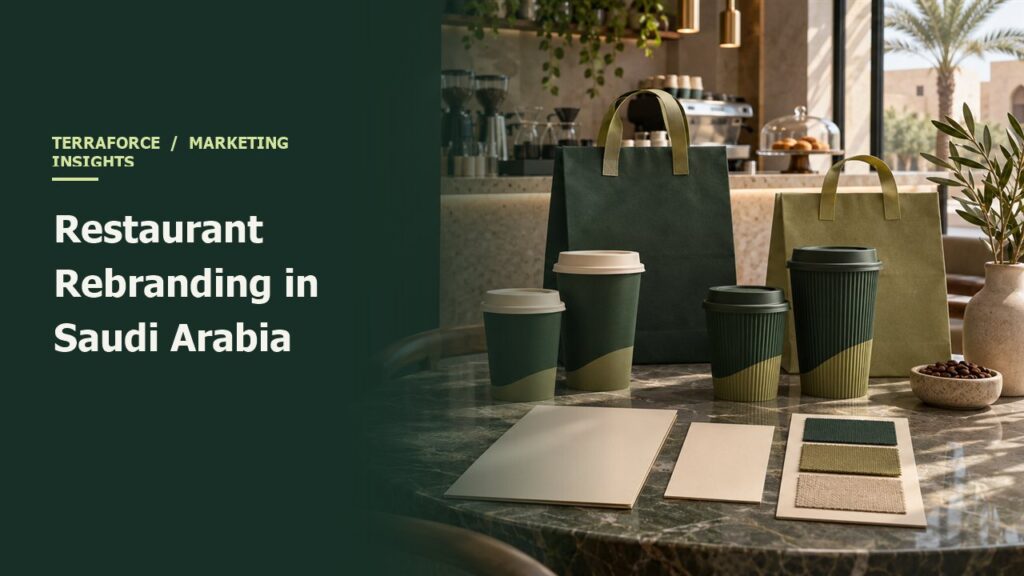
Restaurant rebranding in Saudi Arabia starts with a question about the business: what has changed that guests need to understand? An established neighbourhood bakery moving into gifting has a different brief from a restaurant whose menu, price point and service have shifted together. In the first case, the name and familiar visual cues may still be doing good work. In the second, the restaurant may need to reconsider the promise those cues communicate.
TerraForce brings positioning, identity, creative production and launch planning together through its marketing and communications services and Marketing Portfolio. This guide is for owners who already have a trading brand and need to decide what to retain, where to spend first and how to introduce the change across branches and channels. Start with a recorded problem and end with assets that your teams can use on an ordinary trading day.
- Decide whether the problem needs a visual refresh or a new position.
- Test familiar cues on menus, packaging and digital listings.
- Plan the change around branch readiness, stock and search visibility.
Explore this guide
Decide whether you need a refresh or a rebrand
A refresh keeps the core proposition and repairs its expression. A café with a loyal audience and an accurate offer might need a stronger menu hierarchy, better photography and a more coherent packaging system. A rebrand revisits the proposition itself: whom the business serves, which occasions it competes for and what makes its offer valuable. A name change is a separate decision, with additional implications for discovery, signs, suppliers and customer recognition.
Separate problems by what guests observe. If they cannot find the right branch online, solve information architecture and location maintenance. If they expect fast takeaway but the business is now designed around reservations and a longer meal, investigate positioning. If ratings repeatedly mention slow order handoff, operations must be part of the remedy. Ask each stakeholder to write down one change they expect customers to notice and one that matters only to the internal team. Comparing those answers often exposes where the brief has become too broad.
Audit what customers recognise before changing it
Collect screenshots of both language versions of the website, map listings, delivery pages and social profiles. Add photos of the frontage in daylight and at night, the printed and digital menus, bags and delivery labels. At each touchpoint ask a practical question: can a guest recognise the restaurant, identify the offer and take the next action? Document differences by branch, rather than judging the newest branch as if it represents the whole business.
Use staff interviews and a small number of guest conversations to identify recognition cues. Some people remember a colour, a product name, a silhouette on the storefront or a specific phrase used by staff. Ask customers to describe the restaurant before showing a proposed design. Record what they recall, then separate spontaneous recall from preferences they express after seeing alternatives. This simple distinction helps prevent a feedback meeting from becoming a vote on which logo looks best in a presentation.
Build a keep, improve and retire list
Give each asset one owner and one decision. Keep the elements that are still recognised and fit the direction. Improve assets that matter but currently create friction, such as a well-known cup with poor size identification or a signature menu section that is hard to find on mobile. Retire patterns that actively mislead, such as a premium service image for a branch that only offers takeaway. Attach evidence to each decision so that new team members can understand why it was made.
Discuss the cost of replacement before committing to a broad rollout. A signature colour might appear on signs, uniforms, printed stock, furniture and vehicles. Keeping it while changing its use may make the launch more manageable. On the other hand, retaining a wordmark that guests cannot read from the street may preserve the wrong thing. Review the trade-off on actual surfaces, in both languages, with the people responsible for ordering and maintaining them.
Turn the positioning decision into a usable brief
Write a short statement covering the audience, the occasion, the offer and the proof. For example, a restaurant may be designed for families ordering a shared weekend meal and have packaging and service built for that occasion. That statement is useful because it guides portion imagery, the menu order, the tone of the campaign and the pickup experience. A generic promise about quality gives the designer little to test and can produce interchangeable creative directions.
Include a separate section for constraints. List the current branches, service models, price range, languages, assets that must remain and changes already planned. Add the owner of each approval and identify which decisions will affect suppliers or operations. TerraForce’s concept and brand innovation service can help align the offer with the identity brief. The restaurant branding guide is useful if your team still needs to define positioning, voice and the basic identity system.
Make Arabic and English work in real situations
Review wordmarks on a cup sleeve, a shopfront and a small delivery thumbnail. A combination that looks balanced in a horizontal slide may be awkward on a narrow screen. Decide when to show both languages together and when a single language version serves the channel. Compare readability, spacing and recognition using actual names and approved copy. Test product and branch names with the spelling customers encounter when searching or ordering.
Keep an approved naming sheet for the brand, branches, signature products and short calls to action. Give it to the designers, translators, platform managers and restaurant team. Where a phrase does not translate naturally, keep the promise equivalent and write a version that sounds familiar to each audience. Check mixed-direction text, including prices, contact numbers and ordering instructions, on the devices guests use. The finished bilingual system should make updates easier when a menu changes, a branch opens or a seasonal item comes off sale.
Test the menu, packaging and physical experience
Choose two or three representative orders before approving mockups. Watch someone find a dish, compare choices, identify a price and place the order in the right language. For packaging, run a real pickup or delivery sequence. Check labels on a packed bag, where the design may fold or become obscured, and ask the team to identify the correct box during a mixed order. Our restaurant packaging design guide covers samples, approved artwork and reorder details.
Prioritise what each physical application needs to do. The external sign helps visitors find the venue. A counter board makes popular choices and ordering instructions visible. A delivery label distinguishes items and leaves room for handling details. The interior may need a smaller set of materials or graphics where the existing space already works. Test the connection between menu layout and service: a design that draws attention to a product the kitchen cannot consistently serve will create an avoidable problem.
Keep the restaurant discoverable during the switch
Create a checklist covering the website, map profiles, social bios, booking links, delivery storefronts and printed codes. Record where the old name or design appears, who controls each destination and the review time needed to make changes. When URLs change, map the important addresses to their appropriate replacements and verify the redirects after release. Keep branch details and service hours aligned across profiles. If a QR code is already printed, test its destination before a redesign changes the page structure.
Plan a short, factual explanation for existing guests. Explain what they can expect at the branch, which familiar products or services remain available and where they can find the updated menu. Use plain language if the change affects reservations, prices or ordering. Our restaurant website design guide covers branch pages, menus and booking handoffs. The local SEO guide for restaurants explains the work that helps people find and recognise the right location.
Sequence the rollout around stock and service
Start with a pilot that has a clear objective. For example, one café branch can test menu readability and order packaging while the rest of the group keeps trading normally. Agree which assets will change together and which can follow when stock is used. A launch can be phased, but the guest should be able to connect the new sign, the online listing and the takeaway pack during the transition. Use clear temporary messaging when an old and new asset will appear side by side.
Create a release sheet listing the asset, the branch, the supplier, the person responsible and the approved file version. Decide how to handle old stock and where replacement assets are stored. Ask front-of-house staff to rehearse how they will explain a name, menu or service change. If a paid launch is in scope, use the paid social guide for restaurants to plan a branch-specific destination and a measurable action before releasing campaign creative.
Set a baseline and measure the problem you wanted to solve
Use comparable periods before and after launch and note changes in trading hours, offers, seasonality, menu prices and distribution. A café rebrand that coincides with a new location should not treat every additional order as a design result. Look for practical signals that relate to the brief: fewer menu questions, fewer guests sent to the wrong branch, clearer product recall or fewer mismatches between listing information and staff answers. Choose signals the team can collect without creating a new administrative burden.
Set a review date and decide in advance what action a poor result triggers. If staff receive repeated questions about the new name, test the transition copy and map listings before redrawing the brand mark. If the visual system is consistent but fewer guests complete a booking, check the booking path and availability first. Keep the launch record and asset inventory after the review. They are useful when another branch opens or when the brand has to adapt to a new channel.
A fictional café example: refresh the system around a familiar cue
Imagine a two-branch café with a dark green cup that customers readily recognise. It wants to add boxed pastries for weekend pickup, but the new items are hard to find on the menu and every branch uses a different ordering message. The owner asks for a new logo. An audit shows that the cup and name still work, while the menu structure, packaging sizes and pickup information are inconsistent. The brief keeps the main colour and name, builds a flexible pastry label system and makes the pickup flow visible in both languages.
The pilot uses one branch and a fixed pickup window. Staff record questions about size, order location and collection time. The manager tests the existing QR code, the updated menu page and the message sent at confirmation. The team reviews whether the assets make ordering easier before deciding if the refresh is ready for the other branch. This scenario is illustrative, with no claims about TerraForce client results.
What to ask TerraForce to deliver
Share the reason for the change, your branch list and the channels customers use today. Bring real examples of assets that confuse people and assets you want to protect. Ask for a proposal that separates the brand audit, positioning, identity work, packaging, creative production and launch support. Agree where the scope ends, which supplier proofs are needed and how the working files and guidelines will be handed over. Give the restaurant team access to the approved naming sheet, templates and practical instructions for recurring updates.
For an example of a refreshed identity, see the Le Grenier À Pain project in TerraForce’s selected work, which presents logo, packaging and typography applications. Treat portfolio work as a reference for scope and execution. The right brief depends on the problems your own customers and teams face. Talk to TerraForce with your current menu, a few photos and the change you want guests to notice first.
Questions about rebranding a restaurant
Can we keep the name and still change the identity?
Yes. Keep the name when it still fits the offer and customers recognise it. The scope may include typography, photography, menu hierarchy, packaging and digital applications. Test the new system in realistic situations and agree which parts of the existing identity carry forward.
What should go live first?
Make sure guests can find the correct location and access the menu or booking information. Coordinate those updates with the sign, staff briefing and any announcement. Decide when remaining items such as uniforms, packaging and printed menus can be replaced based on actual stock and supplier lead times.
What affects cost and timing?
Branch count, number of assets, bilingual approvals, photography, signs, print quantities and platform handovers all affect scope. Ask for a phased quote and identify which items involve suppliers. Separate strategy and design fees from production, installation and media so you can compare proposals and decide what to release first.