
Restaurant Website Design in Saudi Arabia: Menus, Reservations and Orders with TerraForce
Plan a bilingual restaurant website with TerraForce: readable menus, branch pages, reservations, ordering, mobile usability and search visibility.
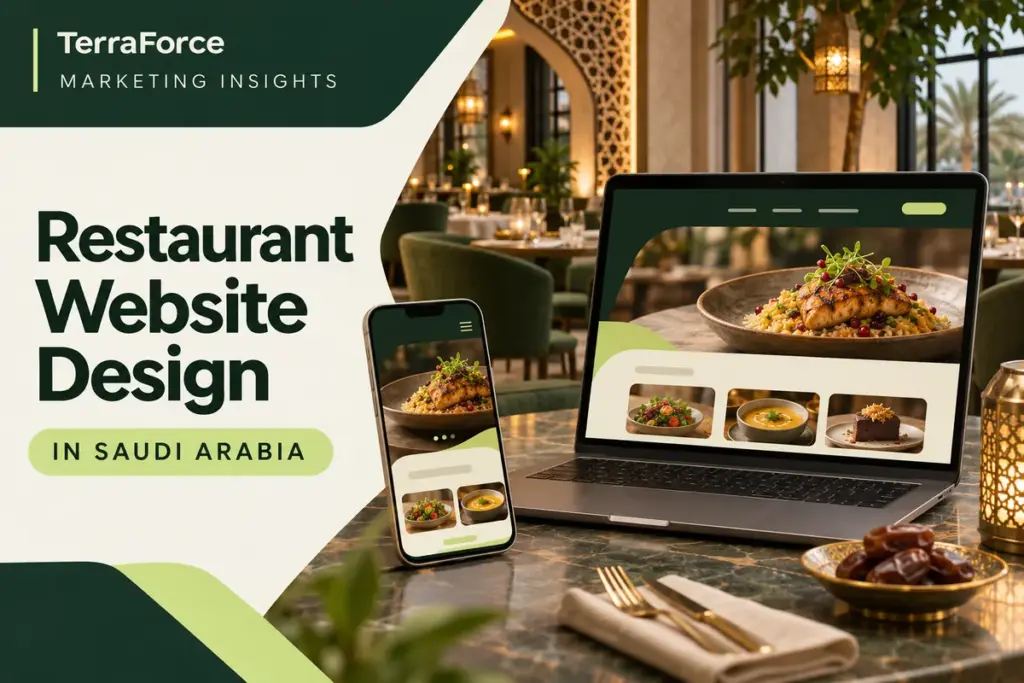
Restaurant website design in Saudi Arabia should make a guest’s next decision easy. Someone looking for lunch wants a menu and the correct branch. A family planning dinner may need opening hours and a dependable reservation route. A takeaway customer needs to know whether the chosen location accepts orders and what will happen after tapping the button. An attractive homepage helps introduce the restaurant, but those practical answers are what make it useful.
TerraForce offers website design, development and SEO as part of its marketing and communications services. Its Marketing Portfolio shows how strategy, creative production and digital execution can share a direction. This guide helps owners prepare a website brief, compare booking and ordering options and check that the finished site can be maintained by the team that uses it.
TERRAFORCE · MARKETING INSIGHTS
What to take away
- Define the guest tasks before deciding the page count.
- Test the menu, branches and booking or order handoff in both languages.
- Agree ownership, search checks and the update routine.
Jump to what you need
Explore this guide
Stages to review
- BriefGuest tasks
- StructureMenu and branches
- DesignBoth languages
- TestBooking and orders
- HandoverUpdates and review
Define the guest actions before planning the pages
Write down the most important reasons people come to the site. For one concept it may be viewing a menu and getting directions; for another it may be booking a table or making a qualified catering enquiry. Give each action a clear destination, and decide who owns the response behind it. If the restaurant does not operate a reservation process, a prominent Book now button is not a useful substitute for deciding how guests are received.
Identify the pages that support those decisions. A small restaurant may need a home page, readable menu, location details and contact information. Multiple branches or a varied offer may need more structure. A catering enquiry may require its own page and brief form because it is different from a table booking. The objective is a site visitors can understand quickly and the restaurant can keep current, not the largest possible page count.
Put a readable menu on the website
A usable menu answers what is available, how the offer is organised and whether choices vary by branch or service period. Use visible text for category and item names, and publish prices and details after checking them against the approved source. Make the layout comfortable on a phone without forcing the reader to pinch and zoom. A downloadable PDF can supplement an online menu when there is a practical reason to print or share it.
Give each menu an owner and a review routine. Separate descriptions that change frequently from assets that take longer to replace. Define how unavailable items, seasonal menus and branch differences are handled. Use approved photos that reflect the actual offer; a gallery can help guests decide without making every menu item depend on a large image. Our restaurant photography guide explains how to prepare images for several channels from a coordinated brief.
Make branch information easy to find and maintain
Use the branch names customers actually see on maps, signs and ordering platforms. Give each location its correct address, hours, contact route and relevant menu or service information. If branches have genuinely different offers, a useful location page can explain those differences. Avoid producing nearly identical pages solely to target city keywords when they do not answer a different question or serve a real location.
Test the route from a branch page to directions, bookings or delivery. A link can work technically and still send the guest to another branch. Put a named person in charge of holiday hours and operational changes across the site and relevant profiles. The restaurant local SEO guide covers local discovery in more depth; the website project should establish the pages and maintenance routine that support it.
Choose an honest reservation experience
Distinguish a reservation request from an immediately confirmed booking. If a staff member must check availability, say so and give the guest a clear next step. If an external system confirms a table, test which branch, date, party size and policies the guest sees, and what happens when no table is available. Do not design a confirmation message until the actual service process is understood.
Choose between a link, embedded tool or deeper connection by comparing the guest experience and who will support it. Clarify the existing vendor, fees, capacity rules and accessibility before treating integration as part of the scope. Keep any form proportionate to the task. A restaurant that already has a workable booking system may gain more by improving the route to it than by introducing another place for staff to check reservations.
Match the ordering route to the business model
A website can link to existing delivery platforms, explain pickup or connect to a direct ordering system where appropriate. Each approach carries different operational responsibilities. A direct order must reach the right branch and be accepted, fulfilled and supported. A platform link is simpler to maintain but still needs correct placement, branch matching and a clear indication that the guest is leaving the website.
Confirm whether the menu, prices and availability are shared or maintained separately. If a proposal includes synchronisation, ask which system is authoritative and what happens when the connection stops. Define how the team handles an unavailable product, a failed handoff or an order outside the intended service area. Review the delivery profitability guide before choosing a channel based on headline fees or attractive interface demonstrations alone.
Design Arabic and English as complete journeys
Start with equivalent pages that provide the same approved facts. Use natural phrasing rather than translating every line literally, and make sure prices, location details and booking instructions match across languages. Test right-to-left layouts with real menu names and actual button text. Check where mixed Arabic and English content appears together, such as a product name, telephone number or booking reference.
The language switch should take guests to the equivalent page where one exists. Agree how both versions are reviewed when a menu or location changes. Test focus visibility, readable contrast, labels on forms and keyboard access for important actions. Good bilingual design is part of service quality: the guest should reach the same useful information whether they start in Arabic or English, without having to navigate back through the homepage each time.
Balance creative expression with mobile performance
Select imagery that shows what makes the restaurant distinctive. The first visual should explain the offer, location or occasion rather than simply occupying the largest area of the page. Use suitable image sizes and formats, and avoid making a heavy autoplay video the only way to understand the brand. Check the page on real devices, including the menu, branch links, forms and interactions used by guests who arrive during a busy day.
Discuss what will happen as the team adds more photos, plug-ins or third-party widgets. Performance is easier to maintain when editing rules and asset guidance are part of handover. A single speed score from a demonstration does not prove that a booking widget or external order page works well. Ask for tests of the priority journeys, with the actual content and integrations in place, before approving launch.
Set up search visibility as part of the build
Give important pages distinct titles, descriptive headings and useful content. Connect related pages with descriptive links, so visitors can move from a branch to its menu or from a campaign to the right offer. Check that public pages intended for discovery are accessible, use appropriate canonical addresses and appear in the sitemap where relevant. Review language alternatives when both versions exist and preserve valuable existing addresses or plan redirects when rebuilding.
Search visibility is a long-term outcome, not a promise attached to a design mock-up. Ask who checks indexability after launch, who follows impressions and clicks, and how new pages are approved. Keep information updated as the restaurant changes. TerraForce can align website work with restaurant launch marketing so early campaign materials lead to the right live pages, not an unfinished destination or an incorrect branch.
Measure actions without confusing clicks with sales
Select a small set of meaningful actions: viewing directions, starting a booking, sending a qualified enquiry or completing a reservation where reliable confirmation is available. Describe what each measurement can actually show. A click to a delivery platform indicates a handoff, not proof of a purchased meal. A submitted enquiry is not automatically a confirmed event booking. Separate these stages in reports and use comparable periods when reviewing results.
Agree measurement ownership and privacy responsibilities before installing additional tools. A technical handoff should document what is measured, where records are reviewed and how approved changes are made. When a printed package drives a visit, use a clear destination and test it through the actual print sample. Our restaurant packaging design guide explains how a long-lived printed link can connect the takeaway experience with an editable menu or branch page.
Test realistic tasks before launch
Ask someone unfamiliar with the site to find a branch, open a menu in the preferred language and reach the right booking or ordering route. Observe the steps they take. Test links from social profiles and any printed codes in scope. Check what happens when a form is incomplete, a venue is closed or the external destination does not load. Fix blocking issues and repeat the affected task rather than relying only on a checklist that says the link exists.
Use a simple acceptance record: task, starting page, expected result, actual result and owner. Include checks for visible content, mobile readability and contact information. Determine who monitors incoming enquiries and how the team handles an outage or urgent change. The final review should include the people who will maintain the restaurant’s information, because a website is only as useful as the accuracy of what customers see after launch.
A fictional example: a group with inconsistent menus
Imagine a small restaurant group whose social profiles send every guest to one generic PDF. One branch has a different breakfast service, and the booking link defaults to the flagship location. In a planned rebuild the team creates a branch selector, gives each relevant menu a maintainable page and checks each reservation path with the vendor. This is a hypothetical project, not a TerraForce case study or a claim about growth.
The first review checks whether people can find the right menu and book the intended branch. Only then does the team compare enquiry and booking data against a meaningful baseline, allowing for changes in hours or campaigns. The same reasoning applies to a single restaurant: solve the observable problem first, define what success would look like and decide what evidence can support a later commercial conclusion.
How to brief TerraForce for a restaurant website
Share your concept, current website and brand assets, the branches and their approved information, the menu owner, the reservation or ordering vendor and the main guest tasks. Flag the problems you see today and the changes already planned. Specify whether you need creative direction, bilingual content, development, photography, SEO or ongoing support. A proposal should distinguish included deliverables from external tools, hosting, vendor charges and later maintenance.
Confirm who owns the domain, hosting access, content and design files. Agree the review stages, handover, backups and responsibilities for updating both languages. Contact TerraForce to discuss the right scope for your next site or rebuild. Start with the decisions your guests need to make, then build a website that can guide them through those decisions and that your team can keep accurate over time.
Questions about restaurant website design
Is a restaurant website still useful if we use social media?
A website can provide a stable, searchable home for the menu, branch details and actions the restaurant controls. Social media can still help discovery and communication. Use both in a way that makes information consistent, and link campaigns to the page that answers the relevant guest question instead of expecting each channel to contain everything.
Does every site need direct ordering or a booking integration?
No. Begin with the operating model and the systems the restaurant can support. A clearly labelled link or enquiry process may be appropriate; a deeper integration is worth discussing when it solves a specific problem and ownership, vendor compatibility and support are understood. Test the real handoff before launch.
What affects the scope and cost of a bilingual website?
Consider branch count, menu complexity, photography, copy, language review, booking or order integrations, migration and support. Ask for an itemised scope and an explicit handover rather than comparing page counts alone. This makes proposals easier to compare and helps prevent assumptions about who will update the site after delivery.