
Cloud Kitchens in Saudi Arabia: Launch, Operations and Unit Economics
Evaluate a delivery-first concept through product travel tests, kitchen capacity and contribution per order. A practical cloud-kitchen launch and review guide.
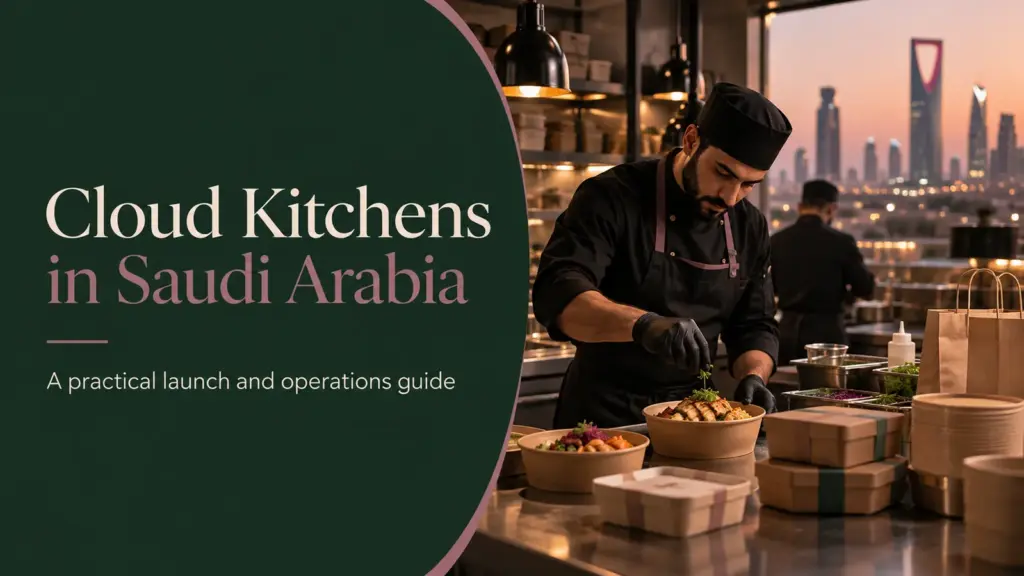
Orders can grow while the kitchen still struggles to cover its costs. Before choosing a site or promoting a delivery brand, test three things: the food after its journey, the team at peak demand and the contribution left by each order.
Three tests before you commit
- Validate a specific customer need and delivery territory.
- Test the complete journey, including packing and courier handoff.
- Compare channel contribution with the fixed costs and capacity it must support.
- Use documented evidence to decide whether to improve, expand or pause.
Validate the concept and territory
What is a cloud kitchen, and when does the model fit?
A cloud kitchen prepares food primarily for delivery or collection rather than seated service. The customer may discover the brand on a delivery platform, a search result, a social channel, or its own ordering site. The absence of a dining room can reduce some fit-out and front-of-house requirements, but food production, hygiene, staffing, equipment, utilities, packaging, licensing, and marketing still need funding. A lower opening bill is therefore a hypothesis to test with local quotes, not a universal property of the format.
The model fits a product whose quality survives the journey and a service area with enough relevant demand. It can suit a brand whose promise is convenience, a restaurant trying a tightly defined delivery menu, or a team validating a concept before a larger opening. A concept built around atmosphere, ceremony, live presentation, or substantial table service may lose its main advantage when compressed into a box. Compare the two models around the same customer need, order size, staffing pattern, and location rather than comparing rent alone.
Start with a restaurant feasibility study that states what must be true for the model to work. Document the intended customer, buying occasion, delivery radius, peak periods, likely order volume, and the constraints that could invalidate the idea. The decision should have a stop rule: what evidence would make you change the menu, move location, delay opening, or abandon the concept?
Does the model fit the way you intend to serve?
| Decision question | Evidence to collect |
|---|---|
| Will the product travel well? | Observed product condition after a representative journey |
| Is there a clear local need? | Customer research and visible competing offers, without inventing their sales |
| Can the team handle the peak? | A timed operating test and observed station constraints |
| Will orders contribute enough? | Channel-level variable costs, fixed costs and achievable capacity |
Research a delivery territory before signing a lease
Traffic past a storefront matters less than a reliable route from the kitchen to the customer. Map the neighborhoods you expect to serve and test real travel times at lunch, dinner, weekends, and events. Consider roads, building access, driver waiting space, and the difference between an advertised platform radius and the time food can remain attractive. A cheap unit at the edge of an attractive district may create slow journeys and poor ratings; an expensive unit in a dense area may still struggle if competing offers are stronger.
Observe the customer as well as the map. Search the delivery applications for the categories you intend to enter at the hours you intend to sell. Record visible menus, portions, delivery fees, ratings, review themes, packaging complaints, promised times, and discount patterns. Do not assume that an app’s public listing reveals its actual sales. Interview potential customers or run a limited test where possible. Ask which meal occasion you can serve better, not simply whether people like the cuisine.
Keep a territory worksheet: customer group, occasion, competing offer, expected journey, product risk in transit, channel used, and evidence source. Revisit it after the launch because the first orders may reveal a different catchment. TerraForce’s concept and brand work can turn this research into a focused proposition before equipment and identity are locked in.
Design a repeatable order journey
Design a menu for travel, speed, and repeat orders
A delivery menu should be smaller and more deliberate than the total number of dishes a kitchen can cook. Each item needs a clear reason to exist, a reproducible recipe, a preparation path that does not choke the peak, a safe and attractive delivery format, and a realistic selling price. Test the food at the time a customer is likely to open the pack, not only at the pass. Evaluate temperature, texture, appearance, sauces, leakage, labeling, and whether the packaging is easy to handle.
Build an item card with ingredient yield, portion, packaging components, expected preparation time, station, modifiers, and allergens. A popular item can still hurt the operation if it requires too many touches during a rush or arrives badly. Conversely, an easy-to-produce item may be the best hero product when its delivered experience is consistently strong. Use kitchen layout and workflow planning to check whether the proposed menu fits the available stations, storage, ventilation, and pickup flow.
Before adding another virtual brand, check whether it truly serves a distinct customer need. Shared equipment may make a second label possible, but it also adds inventory, photography, listings, training, packaging, and quality control. Put the first menu under operational pressure before multiplying brands. If an ingredient is shared, its purchasing and shelf-life rules should be visible across both menus.
Choose the site and check current Saudi requirements
Shortlist sites against both commercial and operating criteria: service area, achievable dispatch time, access for receiving goods, safe movement of staff and couriers, available power and water, drainage, ventilation, storage, waste handling, and room for the stations the menu requires. Check the lease’s permitted use and the practical cost of adapting the premises before committing. A site that looks affordable on rent can become expensive if the services or layout cannot support production.
For regulation, use the current activity-specific information from Balady and applicable food-safety guidance from the Saudi Food and Drug Authority. The exact route can depend on activity, municipality, premises, and service model. Have a qualified local advisor confirm the licenses, health requirements, delivery and signage conditions, staff requirements, and any approvals before signing contracts or fitting out. Do not interpret a generic cloud-kitchen checklist as permission to operate a particular unit.
Plan the physical route from receiving to storage, preparation, cooking, packing, and courier handoff. Cross-traffic creates mistakes. Couriers need an identifiable collection point that does not block hot work or cold storage. The design and launch service addresses how a usable brief becomes an opening plan; use it alongside technical specialists who approve the site-specific food-safety and building details.
Build the order-to-dispatch workflow before advertising
Draw one real order from first click to delivered handoff. Who verifies an item is available? How does the ticket reach its station? Who checks modifiers, allergens, and the customer’s instructions? Who confirms that every component is packed? How is a late courier handled? Write the expected answer for each handoff, then run practice orders on each channel. A slick menu listing cannot compensate for unclear ownership in the kitchen.
Establish recipes and concise standard operating procedures for opening, receiving, prep, production, packing, dispatch, cleaning, and closing. Define what must be recorded and what happens when a check fails. The restaurant SOP manual guide gives a structure for assigning owners, exceptions, and evidence. Train staff to act on exceptions; a checked box after a failed step is not a control.
Set a capacity rule before marketing expands demand. Estimate orders per interval by station and test with an actual timed service. If one station is the bottleneck, pushing more traffic can lengthen every order and damage ratings. Decide who can pause an item, extend a quoted time, or temporarily close a channel. Keep a small log of delays, remakes, missing items, and courier waiting, with causes rather than blame.
Follow one order through six handoffs
Accept
Suggested ownerChannel / order lead
CheckCheck the ticket and item availability
If the check failsResolve an unavailable item through the approved process
Review
Suggested ownerOrder checker
CheckCheck modifiers and customer instructions against the current recipe
If the check failsEscalate an unclear instruction or allergen question
Prepare
Suggested ownerStation lead
CheckUse the controlled recipe and required checks
If the check failsFollow the venue’s exception procedure
Match
Suggested ownerPacking checker
CheckMatch every component with the ticket
If the check failsCorrect missing or incorrect components before handoff
Pack
Suggested ownerPacking lead
CheckUse the tested pack and accurate labels
If the check failsResolve a damaged pack or label mismatch
Handoff
Suggested ownerDispatch lead
CheckVerify the order identity and record waiting exceptions
If the check failsEscalate a delayed or mismatched pickup
Adapt roles to the venue and its approved food-safety plan. This diagram does not define universal holding or transport limits.
Protect food quality through packaging and handoff
Packaging is part of the product. It affects temperature, condensation, texture, leak risk, tamper evidence, labeling, and the customer’s first impression. Run a timed journey test using the route and delay your actual territory may impose. Open the order as a customer would. Photograph the result, note each failure, adjust the recipe or pack, and test again. Avoid a universal promise that every cuisine will survive a fixed travel time; validate each item and delivery radius.
Separate items when their heat or moisture harms one another. Check that sauces, cutlery, and optional items are included only when required. Labels and allergen communication should match the recipe and the platform listing; a substituted ingredient may require an immediate update. Follow the food-safety plan approved for the specific operation when defining holding and transport controls. Train the dispatch checker to verify the order against the ticket before the courier leaves.
If customers repeatedly complain about the same product after delivery, examine the whole chain: production time, wait at the shelf, driver collection, transit, and packaging. Replacing the box alone may not resolve a slow handoff. This is where operations, menu design, and customer feedback must meet.
Make the delivery test observable
| Item / pack | Route & conditions | Journey time | Condition when opened | Issue / next test |
|---|---|---|---|---|
| Record the actual item and packaging version | Record route, traffic and relevant delays | Measure the observed journey; do not assume a universal limit | Record texture, appearance, leakage and relevant approved checks | State the adjustment, owner and retest date |
Understand what each order contributes
Calculate contribution per order, then test the whole month
Gross sales are a poor measure of delivery health. For each channel, start with the order value before the channel fees and merchant-funded discounts you will subtract. If you use a net settlement, reconcile deductions first so that fees and discounts are not counted twice. Subtract the ingredients at the standard recipe yield, packaging, channel commission or processing charge, discounts funded by the business, and other variable fulfillment costs. The result is an order’s contribution toward rent, salaried labor, utilities, maintenance, marketing, and profit. Keep taxes and accounting treatment in a separate, clearly defined line with your accountant. Confirm commission and promotional terms from your own contracts; public examples may not apply to your business.
For illustration only, suppose an order sells for SAR 60, ingredients cost SAR 18, packaging SAR 4, a channel fee SAR 15, and a merchant-funded discount SAR 3. The remaining SAR 20 is contribution before fixed costs and any unlisted variables. Change the assumptions and the result changes immediately. If monthly fixed costs allocated to that channel were SAR 40,000 in this simplified example, 2,000 such orders would cover those costs before a profit. This is arithmetic for decision making, not a benchmark or recommended price.
Now stress-test the model. What happens if the average basket is smaller, promotion spending increases, a key ingredient rises in price, or the kitchen cannot accept more orders at the busiest hour? A monthly total can conceal an unprofitable peak or a costly slow period. Separate delivery-platform orders from direct orders, and compare contribution after the full cost of acquiring and serving each. Use the inventory management guide to connect recipe costing with purchasing, yield, variance, and waste.
See what remains from an illustrative order
60 − 18 − 4 − 15 − 3 = SAR 20
Order value 60, ingredients 18, packaging 4, channel fee 15 and merchant-funded discount 3. The SAR 20 contribution is before fixed costs and any omitted variable costs. With SAR 40,000 monthly fixed costs, the simplified example requires 2,000 identical orders to cover them.
Explore contribution and fixed-cost coverage
Enter SAR amounts on one consistent accounting basis. Start with order value before the merchant-funded discount and channel fees entered below. If you start from a net settlement, reconcile those deductions first to avoid subtracting them twice. Use your own contracts and accountant-reviewed tax treatment.
- Contribution per order · SAR
- 20
- Contribution / entered order value
- 33.33%
- Orders to cover entered fixed costs
- 2,000
Hypothetical example: SAR 20 contribution; 33.33% of the entered order value; 2,000 orders to cover SAR 40,000 fixed costs.
Contribution = entered order value − ingredients − packaging − channel fees − merchant-funded discount − other variable costs. Coverage orders = fixed costs ÷ positive contribution, rounded up. This is not cash flow or a full feasibility model. Values are not sent or saved.
Launch with evidence and a review rhythm
Build demand without becoming blind to channel economics
Delivery platforms can expose a new brand to people who have never heard of it, but their ranking, advertising, fees, and promotional mechanics change. Maintain accurate hours, product availability, photography, descriptions, pricing, and response processes. Track how an offer changes contribution rather than celebrating the order count in isolation. A heavily discounted item may attract one-time buyers while consuming the kitchen’s most valuable capacity.
Develop direct discovery where appropriate: a clear website, search-visible service area information, a consistent social identity, and an ordering path customers can understand. Direct orders still carry payment, technology, customer-service, and marketing costs, so compare true contribution. For a focused acquisition framework, read the restaurant marketing plan. The goal is to learn which channel brings repeatable, profitable demand, not to move every customer to one channel at any price.
Capture useful, privacy-conscious feedback after fulfillment. Ask whether the food arrived as expected, whether any item was missing, and what should improve. Segment feedback by channel and menu item. Review ratings for patterns, but do not assume every negative rating is a kitchen error; log the evidence and investigate.
Measure the first 90 days with a small decision dashboard
Before launch, record a baseline from test orders: order accuracy, preparation time, packaging defects, product condition after travel, and staff readiness. In the first weeks, add accepted orders, cancellations, refunds, average basket, contribution per order by channel, repeated complaints, waste, and repeat purchase where observable. Define each metric and its source. Compare similar days and periods; a busy Friday should not be used to judge a quiet Tuesday without context.
Hold a weekly review with a short list of decisions. Which product should be simplified or removed? Which station needs a layout change? Does a specific channel bring volume but insufficient contribution? Are refunds caused by inventory records, inaccurate listings, or handoff errors? Assign an owner and a date to each experiment, then revisit its effect. A dashboard is useful only when it changes decisions.
At 30 days, focus on consistency and data quality. At 60 days, revisit item economics and the territory. At 90 days, decide whether to improve the existing brand, add capacity, test a second product line, or pause expansion. Treat these periods as a planning cadence, not a guarantee that a concept will prove itself on schedule. For the people side of consistent delivery, use our related restaurant staff training plan.
A dashboard that leads to a decision
| Signal | Evidence / context | Suggested owner | Action to review |
|---|---|---|---|
| Contribution by channel | Settlements, recipe costs and funded promotions on one basis | Finance / operations | Review a weak item or offer |
| Order accuracy and refunds | Ticket checks and documented causes | Dispatch / operations | Test a specific handoff correction |
| Peak delays | Timed station and courier-wait records | Kitchen lead | Review capacity or channel availability |
| Delivered product quality | Observed journey tests and customer feedback | Product / operations | Retest the item, pack or territory |
Use 30, 60 and 90 days as decision points
30 days · stabilise
Focus
Check execution consistency and data quality.
Evidence
Comparable test and order records, with named owners for failures.
Decision
Correct the process and verify the evidence before scaling.
60 days · refine
Focus
Review item economics, channels and the actual service area.
Evidence
Documented menu, channel and territory tests.
Decision
Keep or revise changes using comparable periods.
90 days · decide
Focus
Review capacity, customer experience and contribution together.
Evidence
A brief that records the evidence and remaining uncertainty.
Decision
Improve, expand cautiously or defer expansion.
A suggested review cadence, not a promise that a concept proves itself in 90 days.
Common cloud-kitchen mistakes to avoid
The first mistake is choosing a location solely because the rent is lower. The second is treating platform revenue as profit without examining funded discounts, packaging, and waste. Third, operators often launch too many items or virtual brands before the first workflow is stable. Fourth, they promise a delivery radius the product cannot survive. Fifth, they train for recipe execution but not packing, exception handling, or courier handoff. Finally, they change the menu or price repeatedly without keeping a comparable record of what happened.
None of these errors requires an exotic technology to fix. A product test, a site checklist, an item contribution sheet, observed training, and a weekly review will reveal most problems early. Use tools that fit your size and keep one reliable source of truth for menu, availability, recipes, and reporting.
Turn a warning sign into a specific investigation
High orders, weak contribution
Review funded offers and the complete variable cost of each channel.
Good at the pass, poor at delivery
Test shelf waiting, collection, the route and the pack together.
Late orders at the peak
Find the constrained station before buying more traffic.
More brands, less control
Test the first workflow and incremental capacity before expanding.
Before committing to a site
Selections are not saved and are not regulatory approval or a safety certificate.
Questions before launching a cloud kitchen
Is a cloud kitchen always cheaper than a dine-in restaurant?
It can avoid some dining-room costs, but the answer depends on site works, equipment, permits, staffing, marketing, order volume, and channel fees. Compare full cash needs and unit economics for both models using current local quotations.
Can one kitchen operate multiple brands?
Operationally it may be possible, subject to the applicable permissions and the site’s capacity. Each brand still needs a distinct proposition, accurate listing, controlled recipes, packaging, and customer support. Validate one workflow before adding another.
Which metric matters most at launch?
No single metric is sufficient. Track contribution per order with order accuracy and the delivered product experience. High volume with poor contribution or repeated failures is not a healthy launch.
How should I decide the delivery radius?
Test routes at relevant times and inspect the food when it reaches the customer. Set the radius around acceptable product quality and reliable service, then refine it with real order data.
Turn the concept into an operating brief
Write a one-page decision brief before spending heavily: the customer and occasion, delivery territory, hero items, product-travel results, order contribution by channel, required site capabilities, approvals to verify, peak capacity, and 90-day learning questions. Attach the assumptions that could change your decision. That brief creates a useful conversation between founder, chef, designer, operations lead, and marketing team.
TerraForce helps F&B businesses connect concept, kitchen design, launch, operations, and measurable marketing. If you are evaluating a delivery-first restaurant or a new brand within an existing operation, contact the team with your city, proposed menu, current stage, and main decision. We can help turn the research into a practical plan tailored to the site and the people who will run it.
Take the decision brief into your planning meeting
Download a blank printable HTML file with a one-page project brief and a delivery-test record. Open it in a browser to print or save as PDF. It does not submit project data.
Two blank working templates