
Restaurant Recipe Development in Saudi Arabia: Build a Menu Your Team Can Deliver
Develop restaurant recipes with TerraForce: concept fit, standard recipes, usable yield, costing, kitchen trials and practical team handover in Saudi Arabia.
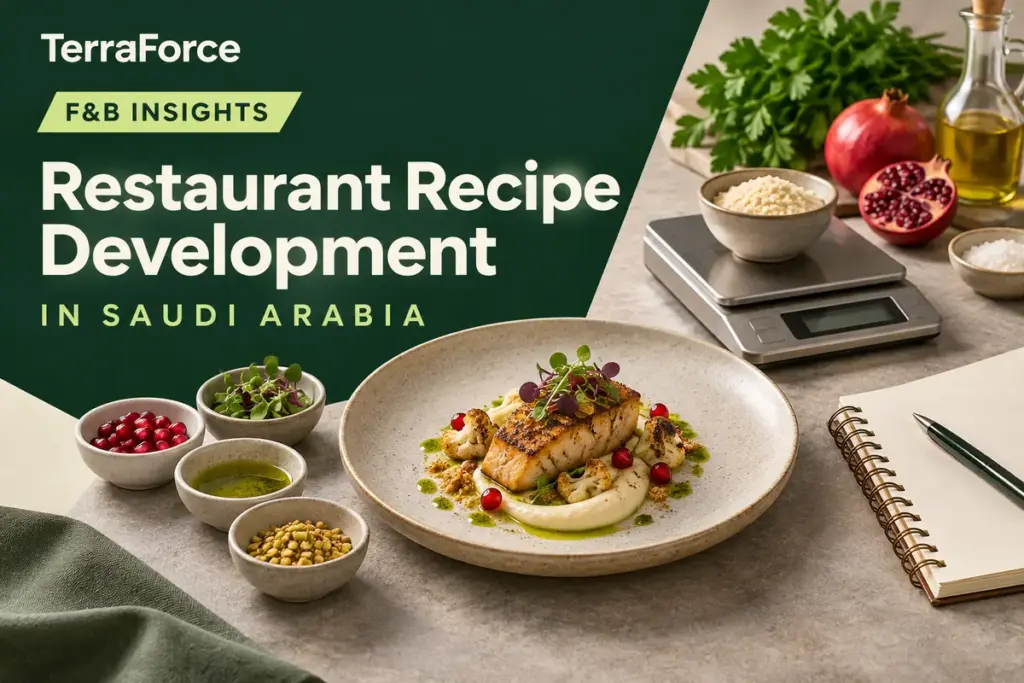
Restaurant recipe development in Saudi Arabia connects a food idea with the people, ingredients, equipment and costs needed to serve it consistently. The objective is a dish guests want to order and a method the restaurant can repeat under normal service conditions. A successful tasting is an important step, but the recipe also needs to survive a different cook, a busy shift, a supplier change and the practical demands of the dining format.
TerraForce lists recipe development, concept refinement, menu engineering, kitchen planning and cost control within its F&B operations consultancy. These connected capabilities are relevant when an owner needs more than a collection of attractive dish ideas. This guide explains the decisions behind a practical development brief, the evidence to collect during testing and the handover that helps a restaurant turn an approved product into everyday service.
TERRAFORCE · F&B INSIGHTS
Your practical takeaways
- Connect the product idea with the concept, kitchen and guest occasion.
- Document yield, portions, method and a controlled route for updates.
- Test real service and agree a usable handover before rollout.
Explore this guide
When does a restaurant need recipe development support?
A new concept may have a strong story but no defined food offer. An established restaurant may have dishes that change between shifts, a menu that has become difficult to execute or a need to refresh part of its offer. A growing brand may discover that its most popular plate relies on one person’s judgement. These situations call for different development scopes, even though each involves recipes.
Write down the problem before requesting a number of new dishes. Is the priority differentiation, consistency, a more manageable production process or a clearer relationship between price and portion? Bring existing recipes, sales information, purchasing records and guest observations where available. TerraForce’s wider consulting services allow the discussion to connect product work with the concept, operation and team rather than treating development as an isolated creative exercise.
Separate development, standardisation and menu engineering
Recipe development creates or refines the product itself: flavour, texture, ingredients, method and presentation. Standardisation documents how the approved product is reproduced. Menu engineering examines the commercial performance of the menu, using evidence such as item popularity and contribution. The activities overlap, but they answer different questions. An attractive new recipe does not automatically solve an unbalanced product mix or an unclear pricing decision.
For an existing menu, determine whether the dish needs reinvention or simply a clearer specification. Keep successful products recognisable unless there is a reason to change them. Use the restaurant menu engineering guide when reviewing the economics and role of each item. A focused brief can then specify which dishes need development, which need documentation and which require a commercial decision before further testing.
A practical project sequence
A discussion framework; project scope defines outputs and responsibilities.
- BriefConcept and constraints
- DevelopControlled product trials
- DocumentRecipe and yield
- TestKitchen and guest use
- HandoverTeam and version control
Start with the concept and the eating occasion
The same ingredient can become very different products depending on the guest and occasion. A sharing restaurant, a quick lunch concept and a delivery-focused business need different portion logic, presentation and preparation systems. Define the desired experience in plain language: what should the guest enjoy, how will the food be eaten and what should make the offer recognisable? These decisions help the culinary work stay coherent.
Link the brief to the restaurant’s positioning instead of following every visible trend. TerraForce’s concept development guide explains how audience, offer and operating model fit together. Identify a small set of product principles, such as a particular cooking approach or a concise flavour direction. Those principles guide choices without requiring every dish to use identical ingredients or reducing the menu to a single visual formula.
Build a development brief that makes trade-offs visible
A useful brief states the dish’s role, intended selling context, indicative price position, portion expectations and operational constraints. It should describe the kitchen equipment available, the skill level of the team, sourcing concerns and whether the product must work for dine-in, takeaway or delivery. Add what must remain distinctive and what can change. Clear constraints make creative testing more productive rather than less ambitious.
Agree how tasting feedback will be assessed and who makes the final decision. The owner may assess concept fit; the culinary team examines execution; operations checks service implications; commercial review considers ingredient cost and the intended price. The deliverable should connect these views instead of presenting a recipe approved on taste alone. TerraForce can be briefed around these connected requirements, with outputs, trials and responsibilities specified in the project scope.
Develop the product through controlled trials
Change one meaningful element at a time when comparing recipe versions. Record the ingredient specification, quantities, method, batch output and observations so the team can understand why a version performed differently. Use the same evaluation questions for comparable trials: does the flavour suit the concept, is the texture right, is the portion appropriate and can the presentation be repeated? Unstructured tasting comments are difficult to turn into a decision.
Keep a version history rather than overwriting the original after every adjustment. Record what was accepted, rejected or left for another test. Where several people taste, capture their observations before discussing a final preference; this helps distinguish a shared issue from the influence of the first comment. The purpose is a usable decision record, not an elaborate scoring exercise that creates paperwork without helping the restaurant choose.
Write a standard recipe that another cook can follow
The approved recipe needs more than a list of ingredients. Include a unique name or identifier, version date, batch yield, portion size, ingredient specifications, quantities and a clear sequence of work. Distinguish a sub-recipe, such as a sauce, from the final assembled dish. Use consistent units and identify whether a quantity refers to the purchased ingredient, prepared component or served portion.
Add presentation references and the quality checks that matter for the product. Storage, handling, allergen information and other food-safety controls should be reviewed by the responsible qualified team for the actual process; a creative recipe sheet cannot establish these details by guesswork. Link daily execution to the restaurant SOP manual guide so the recipe is supported by relevant preparation, service and handover procedures.
Calculate usable yield before trusting the ingredient cost
The purchased quantity is not always the quantity available for portions. Trimming, preparation and other process losses can change usable yield. Measure the actual process for the specified ingredient and record what the yield refers to. A cost based on purchase weight alone can understate the amount consumed by a finished dish. Recheck the assumption when the supplier specification or preparation method changes.
Consider a deliberately simplified fictional example: one kilogram of an ingredient costs SAR 40 and produces 800 grams of usable prepared product. The usable cost is SAR 50 per kilogram, so a 100-gram portion costs SAR 5. If other ingredients add SAR 2, the ingredient total is SAR 7. These are illustrative inputs, not market prices or TerraForce client results, and they exclude labour, overhead and other selling costs.
Questions that turn an idea into a decision
Swipe the table horizontally on a phone.
| Area | What to review | Decision question |
|---|---|---|
| Development | Flavour, texture and presentation | Does the product fit the concept? |
| Standardisation | Quantities, method and usable yield | Can another cook reproduce it? |
| Commercial review | Costs, portion and menu role | What evidence supports the decision? |
| Handover | Practice, ownership and updates | Who maintains the current standard? |
Connect portion, selling price and the full business context
Ingredient cost is an input to a pricing decision, not the complete decision. Portion size, perceived value, preparation effort, packaging, channel charges and the role of the dish within the menu also matter. Keep the calculation definitions clear and use current purchasing evidence. Avoid choosing a selling price solely because another restaurant displays a similar-looking dish at a particular amount.
Review the proposed item within the wider commercial model. Does it complement other products, create an awkward ingredient dependency or increase pressure on the busiest station? The restaurant break-even guide explains why contribution and total operating costs belong in the broader assessment. Recipe work supports that assessment by providing more reliable product information; it should not be presented as a guarantee of a particular margin or sales result.
Test the recipe in the kitchen that will serve it
A development kitchen and a live restaurant can behave differently. Check whether the specified equipment, workspace and staffing can execute the recipe during the intended service period. Observe the sequence across stations, the final assembly and the point at which quality deteriorates if a step is delayed. A dish that depends on an impractical last-minute action may need a different process or presentation.
Coordinate product decisions with kitchen planning and workflow. Review shared equipment and preparation tasks across the whole menu, not one recipe at a time. Avoid adding several products that all need the same constrained station at peak demand. TerraForce’s operations offering explicitly connects recipes and kitchen planning, making these dependencies useful topics for a project discussion before equipment purchases or a major menu launch.
Treat dine-in, takeaway and delivery as separate tests
A product approved at the pass may change after it is packed and transported. Test the actual proposed container, assembly and journey using realistic conditions for the restaurant’s intended service. Examine appearance, texture, ease of eating and whether components should remain separate. Do not assume that a dish needs only a different photograph to become a suitable delivery item.
Document any channel-specific version so the team knows what changes and why. The public description and images should match what the guest receives in that channel. The restaurant delivery profitability guide adds the commercial side of the decision, including packaging and channel costs. Keep product suitability and order contribution connected; a technically transportable dish still needs a commercially sensible place in the offer.
Make the recipe work with the table and guest experience
Presentation is part of the eating experience, but the plate also needs to fit the table, service style and intended occasion. Consider how shared dishes, drinks and utensils occupy the space together. Ask how the guest serves, cuts or combines the components. A dramatic arrangement that requires staff explanation or creates awkward handling should have a clear reason within the concept.
Discuss these requirements alongside restaurant interior design and guest experience. The connection is practical: a sharing menu influences table use, a counter offer changes handover, and a different service sequence affects movement. TerraForce’s integrated service map brings product, space and operations into the same conversation. That relationship helps avoid approving a dish and a dining environment independently, then discovering they are uncomfortable to use together.
Plan purchasing specifications and approved substitutions
A recipe is only repeatable if the ingredient specification is understood. Record the characteristics that materially affect the result, the pack or unit used for costing and how deliveries will be checked. A supplier change can affect flavour, yield and preparation even when the ingredient name stays the same. Keep the team aware of which variations are acceptable and which require a new trial.
Create a controlled route for substitutions instead of allowing informal changes to become permanent. The restaurant procurement guide explains how specifications and supplier comparisons support this work. Coordinate recipe updates with purchasing and inventory records so the version being cooked matches the version being costed. This is especially useful when a business has multiple branches or several people placing orders from different suppliers.
Train for reproduction, then observe actual execution
A recipe handover should include an agreed way to check that the team can reproduce the product. Depending on scope, this may involve demonstrations, guided practice, reference materials and observation during service. Ask another cook to use the documentation and note where they need an explanation. Those questions reveal gaps that the person who developed the recipe may no longer notice.
Use the restaurant staff training guide to connect instructions with observed competence. Record the issues found and update the approved version when a change is justified. Avoid solving every difference through a verbal correction that never reaches the recipe file. The aim is a practical standard supported by the team, with clear ownership of future updates and a consistent route for feedback from daily service.
An illustrative development scenario
Imagine a fictional restaurant preparing a new sharing main course. The first tasting is well received, but the batch yield is uncertain and the final assembly requires several items from a busy station. The chosen platter also leaves little room for the other dishes intended for the table. This is an invented planning scenario, not a report of a TerraForce engagement or a claim about client performance.
The team records yield, trials the assembly in realistic service and tests the full table setting. It compares revised versions against the original concept before approving a final method. Purchasing confirms the ingredient specification, and another cook reproduces the documented recipe. The useful outcome of the trial is a clearer product decision and a workable handover; any later commercial improvement must be measured from actual operating evidence.
How to brief TerraForce on recipe development
Share your concept, current menu, target occasion, kitchen setup and the problem you need to solve. Include existing recipes, supplier information, available costing records and constraints on staff or equipment. Clarify whether you need new products, refinement of existing dishes, standardisation or a broader menu review. This lets TerraForce discuss a scope based on your restaurant’s situation instead of an arbitrary number of recipes.
Ask the proposal to explain the stages of development, tasting approvals, documentation format, handover, training involvement and arrangements for subsequent changes. Confirm ownership of recipe files and images, access to working documents and the distinction between culinary, operational and specialist responsibilities. Review the TerraForce service map and bring the brief to a project conversation, using the connected capabilities relevant to your needs rather than assuming every service is automatically included.
Prepare for the scope discussion
Use while reading; selections are not saved or submitted.
Frequently asked questions
Is recipe development suitable for an established restaurant?
Yes, the need may concern a specific product, inconsistent preparation or a planned refresh rather than a completely new concept. Start with the existing offer and the reason for change. Preserve what guests value, examine available operating evidence and agree which items need creative development, clearer documentation or a different commercial decision before commissioning a larger project.
How is a standard recipe different from a chef’s notes?
A usable standard provides enough approved detail for the intended team to reproduce the product: specifications, quantities, yield, method, portion and presentation. Informal notes may rely on personal knowledge that has not been written down. The right level of detail depends on the operation, and the handover should check whether another cook can use it effectively.
Can one recipe be used across several branches?
It can be the starting standard, but each branch needs suitable ingredients, equipment, training and controls. Test material differences rather than assuming the same file creates the same result everywhere. Define how updates and substitutions are approved, and keep purchasing, costing and execution aligned with the current version before extending the product more widely.
Does recipe development include photography and menu design?
The scope should say so explicitly. Recipe work, menu engineering, visual design and photography are related activities with different outputs. TerraForce lists connected services, but the proposal needs to identify what is included, which approvals are required and who owns the resulting assets. Photograph the approved product and ensure published descriptions match the final offer.
Turn the product idea into a workable restaurant standard
Good recipe development joins creativity with documented decisions, realistic kitchen tests and a practical team handover. It gives the owner clearer information about the offer and provides a foundation for menu, purchasing and service choices. TerraForce’s recipe development and operations capabilities are relevant when these elements need to be coordinated around a new concept, a refresh or a consistency challenge.
Contact TerraForce with your menu, project stage and the product problem you want to solve. Use the first discussion to identify the decisions and evidence required, then agree a scope that connects development with everyday delivery. The strongest recipe is one that expresses the concept, makes sense in the business and can be served reliably by the team responsible for the guest experience.
Discuss the right next step for your restaurant
Share your concept, current stage and priority challenge to discuss a practical scope.