
Restaurant Kitchen Equipment in Saudi Arabia
Choose restaurant kitchen equipment with TerraForce. Compare peak capacity, supplier quotes, installation and commissioning for your Saudi project.
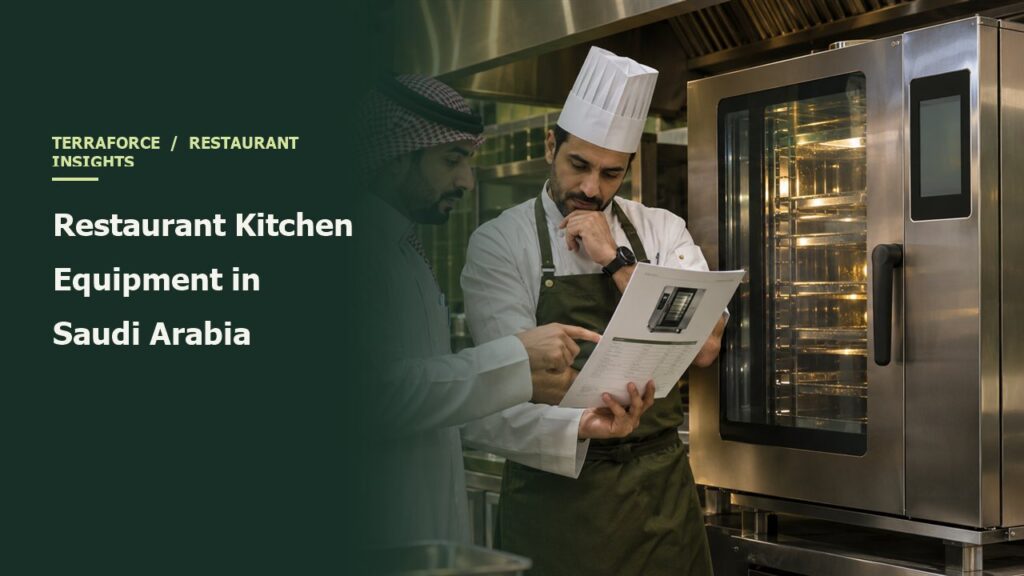
Choosing restaurant kitchen equipment in Saudi Arabia starts with the menu, the busiest service window and the utilities your site can actually support. List what each station has to produce, test its usable capacity, and ask vendors to quote the same installation, commissioning and maintenance scope. TerraForce combines F&B operational consulting with kitchen planning and equipment procurement support so that owners can compare options against how the restaurant will trade.
A supplier can offer a capable oven and a contractor can deliver a beautiful fit-out, yet the kitchen can still fail a Friday dinner because the hot line cannot cook two signature items at the same time. This guide follows the purchase decision from the first capacity estimate through the handover. All figures illustrate the method and should be replaced with observations and quotations for your project.
- Translate the menu into equipment needs.
- Compare usable peak output and installed cost.
- Verify commissioning with a real service trial.
Explore this guide
Translate the menu into work at each station
Print your proposed menu and mark for every dish what happens during prep, what happens after the order, and where it finishes. For example, a chicken dish might require cold storage and portioning in the morning, cooking to order at the hot line, a side from a separate station, and a final check at the pass. The equipment selection has to account for each of those operations. A menu with five dishes and a dozen configurable sides can create more station conflicts than a longer list with shared components.
Document the containers, utensils and staff motions that go with the recipe. Can the worker load a full tray without blocking the next station? Is there a landing space for hot pans? Can someone open a fridge drawer while another person works at the pass? Write down any seasonal items, delivery-only products and special-event menus that keep a station busy. Where portion yield or timing is still unknown, test the recipe first. The restaurant recipe development guide explains how to convert a chef’s prototype into a repeatable recipe card.
Size for the peak window and the true bottleneck
Build a service mix for the busiest consecutive fifteen or thirty minutes you expect. In a hypothetical thirty-minute window, a restaurant receives 48 orders, and 32 require a side that passes through the same fryer. Assuming an eight-minute effective cycle including turnover and recovery, a single basket yielding eight acceptable portions can complete three full cycles and produce 24 portions within that window. Demand exceeds the equipment estimate by eight portions even before accounting for rework. An operator can test an additional basket or station, revise the menu mix, or control order intake for that window.
Run the same exercise on a realistic mix that includes simultaneous dine-in tickets and pickup orders. Ask a vendor to demonstrate a representative batch using the portions, vessels and finishing rules from your kitchen. Check the output quality, cycle time, and whether the unit can sustain the next batch. The useful figure is accepted portions at the pass within the period. Compare downstream capacity, too. More oven output cannot improve service if assembly, dishwashing or the pickup counter is already the limiting step.
Check the building before you approve the quotation
Prepare an equipment schedule with the model, footprint, access clearance and utility requirements for every significant item. Ask the qualified designers and contractors responsible for the site to compare that schedule with the real building conditions and the applicable requirements. Include power and supply capacity, water and drainage, ventilation and maintenance access where applicable. Start with official Balady activity requirements and confirm what applies to the site with the appropriate project professionals.
An equipment substitution after design approval can change more than a counter dimension. A different oven can require a new service connection or have a door swing that reduces a passage. A revised cold room specification can affect access and installation sequencing. Keep the make and model tied to the drawing revision, and route substitutions for review before a purchase order is issued. Our guide to commercial kitchen design explains how to check flow, zoning and station relationships while the project can still absorb changes.
Compare quotations using a common scope
Issue the same equipment schedule to each bidder. Ask for quoted models and quantities, included accessories, delivery location, installation, testing, training, warranty terms, and proposed exceptions. Separate factory lead time from delivery to site and commissioning. Note any site readiness conditions, such as utilities being available for tests, and assign somebody to confirm those conditions. A lead time is only meaningful when everyone agrees what its end point represents.
Build a comparison with columns for what is included, what is explicitly excluded, price, lead time and evidence of local service coverage. Request written clarification for ambiguous rows. Suppose proposal A lists an oven for SAR 31,000, with delivery and commissioning priced separately at SAR 4,600 together. Proposal B lists SAR 33,800 with both included. Before comparing warranty or taxes, their comparable amounts are SAR 35,600 and SAR 33,800. These invented numbers show how a lower unit price can be a higher installed cost. Review critical spares and service arrangements separately from the initial purchase total.
Work out the ownership cost and failure plan
Identify the maintenance interval, consumables, specialist service and replacement parts associated with each shortlisted model. Ask who can maintain the model in your city and how a service call is opened. Ask which parts the provider normally holds and what happens if a key component is unavailable. Obtain commitments in writing where they matter to the decision. Consider the cost of training extra staff when an interface is unfamiliar, and the cost of lost service when one machine handles a large share of the menu.
Classify pieces of equipment by what happens if they fail during service. The team may be able to move a preparation task to a second unit with minimal effect, while a single specialised machine can stop several bestsellers. Write an approved operating response for the critical items, including when the manager changes availability, suspends a channel, or escalates to the maintenance provider. Connect that response with restaurant complaint handling so the team can update guests when a technical problem affects the promise made at ordering.
Sequence delivery, installation and commissioning
Write dates backwards from the first supervised kitchen trial. Identify when each unit must be delivered, when it can be brought inside, and who will receive it. Check doorways, loading access and handling conditions with the project team and supplier. Confirm who will protect the equipment while construction continues and who signs for visible transport damage. A signed delivery slip and a commissioned station are different milestones. Retain both in the project record.
During commissioning verify that the exact approved equipment is installed as planned. Collect records of the testing the vendor and project specialists are responsible for. Arrange a separate activity with the chef to produce a real service sample from the menu once the equipment is ready. Record results, faults, who owns each correction and the date of the repeat test. The TerraForce pre-opening and training service supports launch planning, team onboarding and readiness assessment, which helps the operator move this evidence into the decision about opening capacity.
Teach the crew to run the station under pressure
Ask the team to demonstrate the opening checks, a busy production sequence and the approved closing and cleaning procedure using the manufacturer’s guidance and the restaurant’s own controls. Train across shifts and document what staff are authorised to handle themselves. A demonstration of the interface alone can leave the supervisor guessing how to organise work when two orders require opposing settings or the next shift inherits an unresolved problem. Use the staff training plan to decide who needs observation, retraining or sign-off.
Use the soft-opening guide for a trial that challenges the real sequence through to handover. A chef may successfully cook individual dishes yet encounter congestion when multiple tickets need simultaneous finishing. During an observed rehearsal, time selected tickets and write down why the delay happened. If finished items wait at the pass while drinks or sides are prepared, the result may call for a service change before it calls for another purchase.
Use a short purchasing worksheet
Set up one row per asset with the item description, station, dishes served, accepted output at peak and consequence of failure. Add selected model, dimensions, utilities, equipment price, approved options and bidder exceptions. Record the review owner and approval date. Keep a field for site checks and a field for next action. Start the comparison with the items whose replacement could change the room layout or push back opening.
For example, mark a combi oven as dependent on the hot-line layout and on access for delivery. Compare two models on usable trays, cycle results with the actual menu and the ability to service the unit within the available clearance. Ask your team to confirm how the chosen model will interact with your cleaning routine. The worksheet is usable when the purchasing manager can read it and reconstruct why the decision was made after the chef and contractor have moved to the next problem.
Assess existing equipment before replacing it
In a trading restaurant, assemble recent repair records, production delays, complaints and any items suspended because the kitchen could not produce them reliably. Watch a normal busy shift before seeking a new quote. A unit that appears too small may lose effective capacity because staff are waiting for trays, portions vary or the menu asks for too many settings in the same service period. When a qualified technician has identified a fault, document it alongside the operational observation.
Compare repair, revised work allocation and replacement against one goal such as increasing acceptable peak output or reducing repeated downtime. Estimate the installation disruption and account for the temporary service plan while the unit is unavailable. An upgrade is easier to justify with a test that shows where the constraint is and a measurable improvement criterion. Start with the TerraForce operational audit approach when several symptoms point to different parts of the kitchen.
How TerraForce can support the purchase
TerraForce’s F&B consultancy and operations service covers kitchen planning and equipment procurement, recipe development and cost control. The starting point can be a menu and an empty site, an existing drawing awaiting equipment decisions, or a kitchen that needs changes while continuing to trade. Share the current menu, layout, service channels, expected peak volume and supplier quotations. For an existing branch, include any records that show failures, delays or repeated complaints tied to a station.
Agree on the decision needed first. An owner may need a station-by-station schedule before releasing requests for quotation. Another team may need a comparison of supplier exclusions or an opening readiness review before admitting guests. Discuss your restaurant equipment project with TerraForce and identify what evidence your team needs to approve the next commitment.
Frequently asked questions
What should I purchase first?
Start by confirming the decisions that constrain the building, such as the production model and utility requirements for significant equipment. Coordinate the model specification with your project professionals before confirming the order, then prioritise long-lead equipment with a verified delivery and commissioning sequence.
How do I choose between compact and higher-capacity equipment?
Compare usable output on representative menu items, operating clearances, maintenance access and the options available when the unit is busy or out of service. Model more than one service mix. A compact unit can be viable if demand is deliberately staged and a larger one can still be ineffective if the station lacks labour or preparation space.
Can I use second-hand equipment?
For a shortlisted unit, verify its model, condition, parts support, installation requirements and expected operating output. Have suitability and safety assessed by qualified people. Price transport, recommissioning and restoration alongside the purchase, and agree what evidence is needed before acceptance.